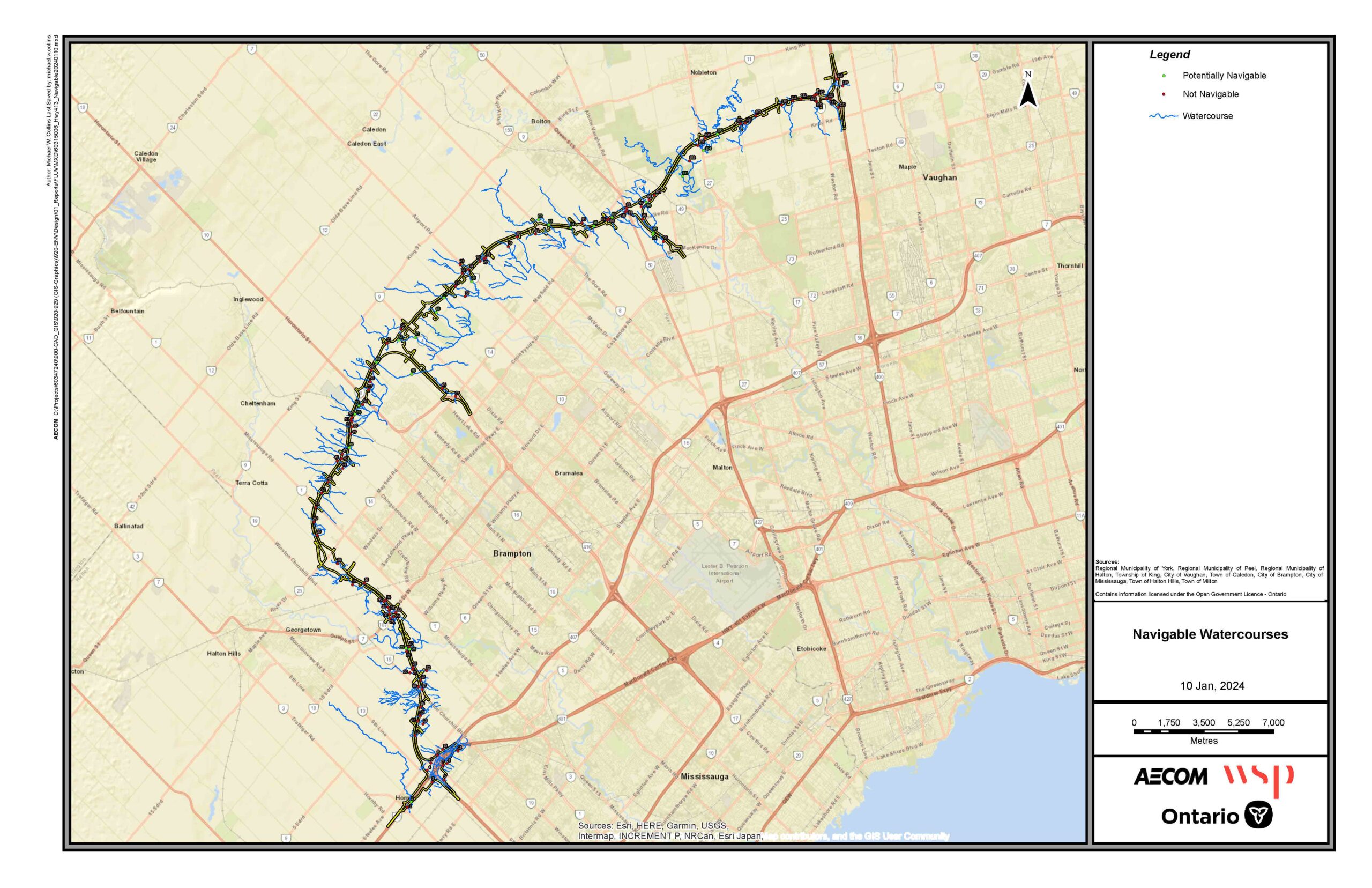
Corridor Designation
On November 27, 2025, the Ontario Government designated the Highway 413 under the Public Transportation and Highway Improvement Act (PTHIA).
When a highway corridor is designated, the Ministry of Transportation (MTO) has formally identified the specific route of the new highway for the purpose of building, operating, or protecting a provincial highway. MTO also has the authority to acquire this land as needed.
Any properties not anticipated to be impacted by Highway 413 or the Northwest GTA Transmission Corridor will be released from the Focused Analysis Area and Narrowed Area of Interest. Properties nearby the now designated Highway 413 corridor will require permits before proceeding with certain developments and activities.
For more information on the Northwest GTA Transmission Corridor please contact nwgtatransmissioncorridor@ontario.ca.
For more information about MTO Highway Corridor Management and permit control requirement please visit the MTO website.
Project Process
The Reducing Gridlock, Saving You Time Act, received Royal Assent on November 25, 2024, as the government of Ontario recognized the need to build priority highways more quickly to keep up with the province's growth and reduce gridlock. Through the Reducing Gridlock, Saving You Time Act statute – the Highway 413 Act, 2024, was introduced to:
- Exempt all activities by or on behalf of the Minister of Transportation that are for or related to Highway 413 from the Environmental Assessment Act and
- Create an accelerated assessment of environmental impact process for the construction of Highway 413 and Highways 410 and 427 extensions. The process will not apply to Highway 413 Early Works projects.
Under the Highway 413 Act, 2024 MTO is required to fulfill the following requirements for the Highway 413 Project:
- Prepare a plan for consulting potentially impacted and interested Indigenous communities, circulate the plan to the communities and implement the plan,
- Assess the impacts of the Highway 413 Project on the environment and identify how negative impacts will be mitigated based on MTO’s Preliminary Design for the project,
- Prepare and publish a draft Environmental Impact Assessment Report (EIAR), which will include a description of local environmental conditions and studies completed (e.g., fish and fish habitat, terrestrial ecosystems, archaeology, air quality, agriculture, noise, socio-economic, drainage and stormwater management), the assessment of impacts of the Highway 413 Project on the environment based on the Preliminary Design of the project, a description of how impacts will be mitigated and the record of consultation,
- Publish a notice of the draft EIAR and provide Indigenous communities, government agencies (including the Ministry of the Environment, Conservation and Parks), interested persons and the public an opportunity to comment on the draft EIAR,
- Prepare a final EIAR, considering any comments regarding the draft EIAR, and publish the final version on the project website,
- Proceed to the Detail Design phase of the Highway 413 Project and undertake a Significant Changes/Addendum Process if required,
- Obtain Any Provincial or Federal permits or authorizations and acquire property.
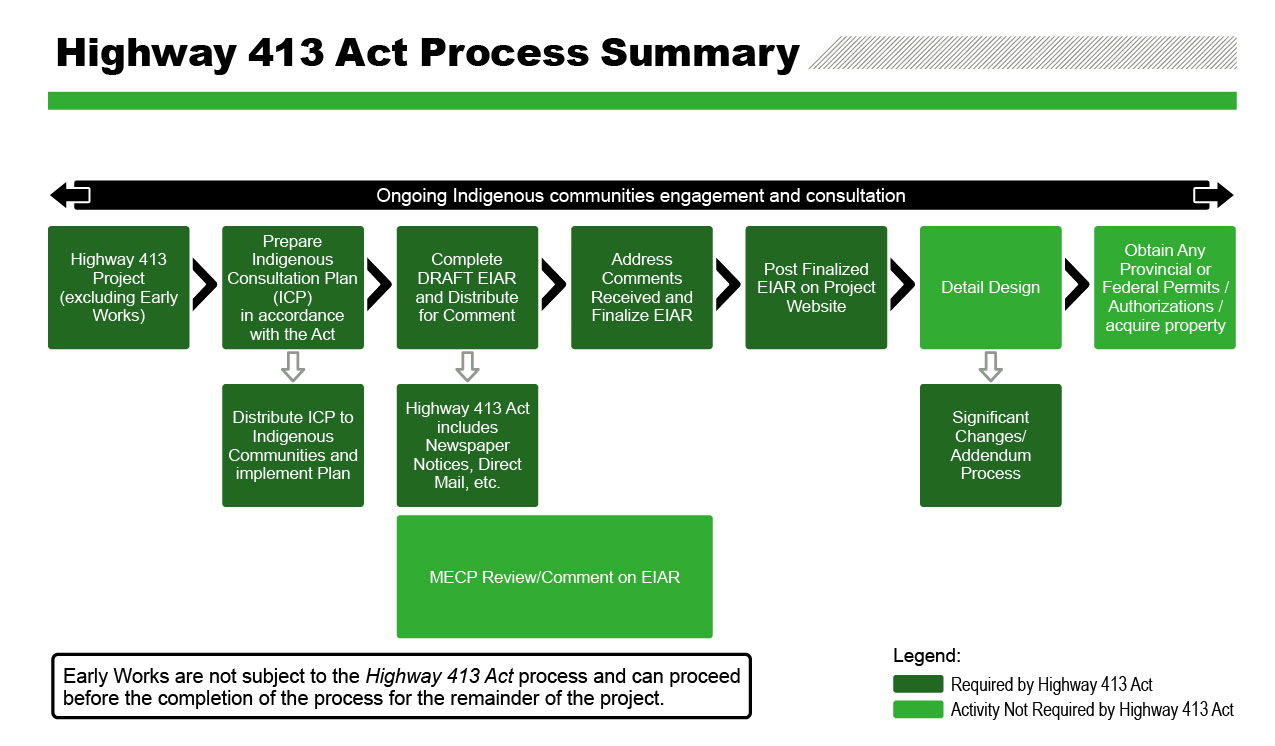
Early Works are not subject to the Highway 413 Act process and can proceed before the completion of the process for the remainder of the project.
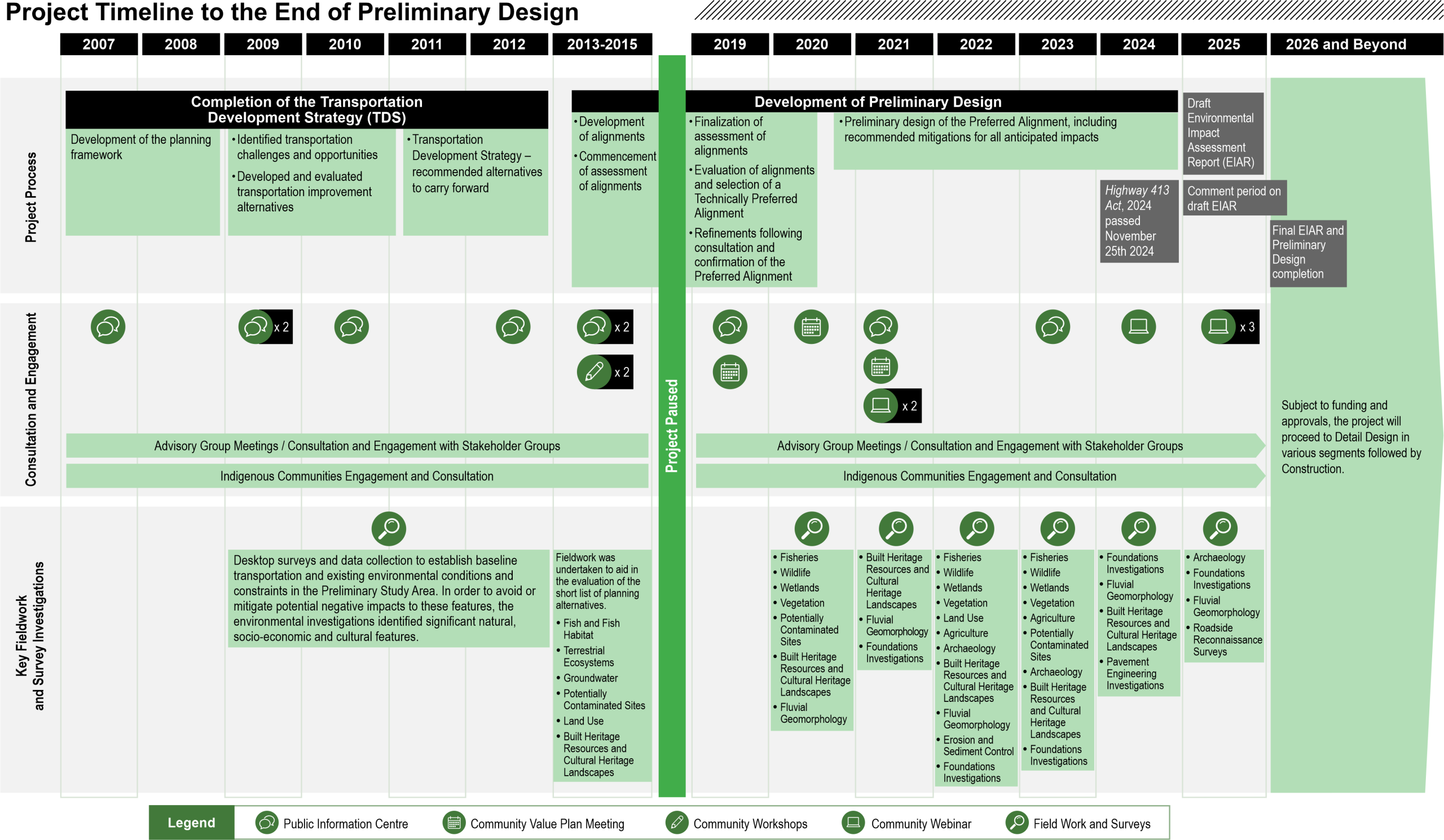
The requirements of the Highway 413 Act, 2024 build upon the considerable work completed on the Project to date, including environmental studies and ongoing consultation and engagement, that MTO and their consultants have undertaken to advance the work since the commencement of the Highway 413 Project in 2007.
Project Timeline
Key Milestones
The Project Team, consisting of MTO and their retained consultants, anticipates the following milestones:
- Design and Reporting Milestones:
- Completion of review period for draft Environmental Impact Assessment Report on January 6, 2026.
- Updating of draft EIAR in accordance with Section 8 of the Highway 413 Act, 2024 and posting of final EIAR to the project website on March 12, 2026.
- Finalization of impact assessment reporting and mitigation alternatives.
- Subject to funding and approvals, the project will go through a Detail Design and procurement phase. This will culminate in the initiation of project construction.
- Continued consultation and engagement with Indigenous communities, key stakeholders and the public.
- Early Works – construction to begin at:
- Early Works Project #2: Resurfacing and Underpass at Highway 10/Hurontario Street.
- Early Works Project #3: Underpass at Bovaird Drive.
Specialist Fieldwork
Fieldwork is being scheduled to support our understanding of existing site conditions and inform the development of the Preliminary Design:
- Inspections and surveys along the Preferred Alignment in public spaces and on properties for which Permission-To-Enter has been granted.
- Borehole investigations to understand soil conditions along provincial and municipal right-of-ways.
Engineering Studies
The highway and transitway right-of-way is preliminary (alignment to be confirmed).
Environmental Studies
We are currently completing studies to establish baseline conditions, complete impact assessments and develop measures to avoid, minimize or mitigate potential effects in the following areas:
Background & Reports- Highway 413

To access our full suite of reports, notices, factsheets, and bulletins, please follow the link below for more information and detailed documentation.